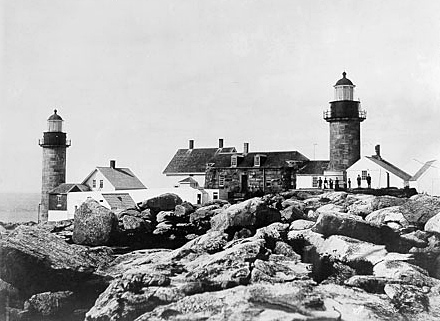
An 1856 winter storm off the coast of Maine isolated Matinicus Rock Light from contact with the mainland for twenty-one days. Its keeper, Samuel Burgess, went to the mainland for supplies the day before the storm arrived. While Burgess was stranded on the mainland for three weeks, his sixteen-year old daughter Abbie heroically tended the two lighthouses and cared for her sisters and ill mother. At least three nonfiction children's books have been written telling the now famous story of Abbie Burgess: 1) Keep the Lights Burning, Abbie (1985) by Peter and Connie Roop, 2) a graphic novel, The Stormy Adventure of Abbie Burgess, Lighthouse Keeper (2011), also by Peter and Connie Roop, 3) and Abbie Against the Storm (1999) by Marcia K. Vaughan. A fictional adaptation, The Lighthouse Keeper's Daughter by Arielle North Olson, also utilizes many details of the Burgess story.
 |
The Lighthouse Keeper's Daughter
by Ariele North Olson;
illustrated by Elaine Wentworth
(From: Amazon) |
In
The Lighthouse Keeper's Daughter, Miranda tends the lamps of an island lighthouse in Maine while her father is stranded on the mainland during a winter storm. Miranda and her mother are forced to ration their supplies over the few weeks it takes for her father to return. He eventually returns with a small boat of supplies, including flower seeds sent by Miranda's grandmother. Miranda noted and lamented the barrenness of the small island when she and her parents first arrived there. When spring arrives, seafarers demonstrate their gratitude for Miranda's light maintenance during the storm by delivering garden soil to the island. The story ends with the lovely scene of Miranda planting flowers on her rocky island.
In her Author's Note at the end of the book, Olson states that
The Lighthouse Keeper's Daughter is a fictional combination of two historical facts: 1) the 1856 account of
Abbie Burgess, 2) gardens were once planted every summer on Maine's Mount Desert Rock, only to be perennially washed away by winter storms. There are additional clues in the text as to the story's setting. The lighthouse is said to warn ships away from the dangers of Minot's Ledge. She also describes the island as being "miles and miles from shore." For readers who are attentive to the consistency of historical fiction with actual geography and the historical record, the setting of Olson's story is lost in a confusion of conflicting facts. For historical fiction, the reader's imagination longs to believe that the story
could have happened, even if it did not
actually happen. If story details conflict with known facts, then the imaginative illusion fails.
The story is generally supposed to occur on the coast of Maine. The news of Miranda's heroic effort to keep the lighthouse in operation "spread[s] all along the Maine coast." However, Olson specifies that Miranda's lighthouse is located on Minot's Ledge.
Minot's Ledge is a barely submerged reef located one mile off the shore of Cohasset, Massachusetts--not Maine. There is a lighthouse on Minot's Ledge. However,
Minot's Ledge Light is attached directly to the underwater ledge, with no island surrounding it. Furthermore, since its construction in the late 1840s, Minot's Ledge Light has always used an (at the time) cutting-edge
Fresnel lens. In contrast, Olson has Miranda tending an older-style light with whale oil lamps and parabolic reflectors.
If we search for an actual lighthouse in Maine that is similar to Miranda's, there are at least two good candidates. One possibility is
Mount Desert Light. Mount Desert Rock, as we have seen, is a barren island eighteen miles off the mainland with a long
gardening history. Another possibility,
Matinicus Rock Light, also eighteen miles off the mainland, was the historical scene of Abbie Burgess's heroism. But Matinicus Rock also has a fair amount of grassy vegetation and two lighthouse towers, unlike the single lighthouse in Olson's book.
There are several similarities between Abbie and Miranda. The lamp technology in both lighthouses was older than the Fresnel lens. They were oil lamps that needed more frequent tending. Abbie describes her practice with them:
"When we had care of the old lard oil lamps on Matinicus Rock, they were more difficult to tend than these lamps are, and sometimes they would not burn so well when first lighted, especially in cold weather when the oil got cold. Then, some nights, I could not sleep a wink all night though I knew the keeper himself was watching. And many nights I have watched the light my part of the night, thinking nervously, what might happen should the light fail. In all these years I always put the lamps in order and I lit them at sunset." (
New England Historical Society)
Abbie and Miranda both come to the rescue of several hens endangered by the large storm waves washing over the island. Again, Abbie remembers:
"You know the hens were our only companions. Becoming convinced, as the gale increased, that unless they were brought into the house they would be lost, I said to mother: "I must try to save them." She advised me not to attempt it. The thought, however, of parting with them without an effort was not to be endured, so seizing a basket, I ran out a few yards after the rollers had passed and the sea fell off a little, with the water knee deep, to the coop, and rescued all but one. It was the work of a moment, and I was back in the house with the door fastened, but I was none too quick, for at that instant my little sister, standing at the window, exclaimed: "Oh, look! look there! the worst sea is coming.
That wave destroyed the old dwelling and swept the rock. I cannot think you would enjoy remaining here any great length of time for the sea is never still, and when agitated, its roar shuts out every other sound, even drowning our voices." (
New England Historical Society)
But Olson distinguishes Miranda from Abbie in a number of ways. Sixteen years old at the time of her ordeal, Abbie was a few years older than Miranda appears to be in Wentworth's illustrations. While Miranda's mother keeps her company on the island while her father is away, Abbie was compelled to not only maintain the two lights, but also care for her ill mother and two younger sisters. Finally, there is nothing in the historical record (that I've encountered) to suggest that Abbie was particularly interested in flower gardening, as Miranda is.
The Lighthouse Keeper's Daughter, published in 1987, has not aged well. Elaine Wentworth's watercolor illustrations of the Maine coast are indistinct and dull. Even for a child who is interested in Maine, I think it would be difficult to get her to pick it up to read. I love the coastal scenery in which the story is set, but only mildly enjoyed the illustrations. Add to this the problem of the story's indistinct setting. I can understand why Olson did not locate the story on a particular island and lighthouse in Maine. She wanted to tell a story that combined Abbie Burgess's tale with Mount Desert Rock's history of gardening. But why mention Minot's Light in Massachusetts? This detail seems to serve no purpose in the plot. It only confuses the reader. For these reasons, I would not recommend this book to children, or even to any adults who are not, like me, so crazy for New England history and geography that they'll read everything ever published about it!