The Girl Who Drank the Moon
By Kelly Barnhill
Genre: Fantasy
Interest Level: Grades 5-8
Reading Level: T
Where to find this book: Winship School Library
Every year on the Day of Sacrifice a baby is left alone in the woods for the witch. The sacrificed baby, say the Elders, pacifies the witch and keeps her from attacking the village or Protectorate. Most of the sacrificed babies' families are numb to this annual reality and do not fight to save the children. A cloud of sorrow perpetually hovers over the Protectorate. But not every family is giving up their baby without a fight. One mother defiantly takes her daughter in her arms and evades the soldier-like Sisters of the Tower who have come to take her baby away. But only for a brief time. The Sisters forcefully take the baby, who has a crescent-shaped birthmark on her forehead, for the sacrifice and lock the mother up in a Tower prison cell.
The people of the Protectorate do not know that the witch who lives in the woods is a kind, gentle witch named Xan. Xan discovers the babies in the forest each year and locates new families for them in the Free Cities on the other side of the forest. The witch does not know why the babies are left in the forest each year--she just rescues the babies when they appear. But if the witch is not demanding an annual sacrifice from the Protectorate, then who is?! The evil Elders who govern the Protectorate use the Day of Sacrifice to control the people and maintain their power. The Elders are backed by a much darker magical being called the Sorrow Eater, someone who feeds on people's sadness as if it were food. The people are kept perpetually sad in order to feed the Sorrow Eater.
Xan discovers the baby with the crescent-shaped birthmark and decides to raise the girl, who she names Luna, as her own granddaughter. But while caring for Luna on the journey home, she runs out of milk and decides to let the girl drink the light of the stars and moon. She accidentally gives Luna too much moonlight, which is full of magic. Luna acquires a destiny as a witch. Xan carefully trains Luna in how to use her magic to help people, not hurt them. Despite Xan's kindness in raising Luna and giving her a home, Luna has dreams and vague memories about her mother and her roots in the Protectorate. As Luna subconsciously explores her Protectorate origins, she confronts the reasons why she became a Day of Sacrifice baby. Can Luna and her grandmother Xan free the Protectorate from the terrible cloud of sorrow that blocks even the sun from shining on their village?
The Girl Who Drank the Moon is a full-fledged fantasy with magic, dragons, witches, and a magical force of love that rules the world. If you liked Harry Potter, I'm pretty sure you'll like this Newbery Award-winning book too!
Wednesday, July 5, 2017
Saturday, June 3, 2017
Nothing But the Truth
By Avi
Genre: Realistic Fiction
Interest Level: Grades 5-8
Reading Level: P
Where to find this book: Boston Public Library
Phil Malloy is nearly failing his 9th grade English class. The explanation for the grade is of course that his English teacher, Miss Narwin, doesn't like him. Or so Phil says. It has nothing to do with the fact that he goofs off in class or that instead of writing an essay on his last test, he wrote a joke making fun of the book The Call of the Wild. The poor grade is a big problem because the coach of the track team will not allow Phil to run with the team unless he improves his English grade.
Phil's solution is to lay a trap for Ms. Narwin. If he can get her into trouble with the principal, then maybe the principal will switch him to a different English class. When Miss Narwin corrects him one morning for loudly humming or singing while the national anthem is being played over the school's sound system, Phil seizes the opportunity. Never mind that making any sounds during the national anthem is against the school rules and is considered disrespectful. Phil tells his parents that Miss Narwin will not let him sing "The Star-Spangled Banner" at school. Phil's parents tell a local politician running for school board, who tells a newspaper reporter, who tells the superintendent of schools. Soon everyone in Harrison, New Hampshire and even in the whole state is wondering why a boy is not allowed to sing the national anthem in school.
Why shouldn't kids be allowed to sing the national anthem in school? Of course, most people don't know the real story. But the consequences that come from Phil's plan are out of control. Phil may not only get his wish of being transferred out of Miss Narwin's class; he also puts Miss Narwin in danger of losing her job. Will Phil lose control of this whole situation? Will he be allowed to join the track team? Will Miss Narwin be fired? Read Nothing But the Truth to find out the answers to these questions!
If you like realistic stories about problems in high school, then you'll want to read Nothing But the Truth.
Friday, May 5, 2017
The Crossover
The Crossover
By Kwame Alexander
Genre: Realistic Fiction
Interest Level: Grades 5-8
Reading Level: Q
Where to find this book: Winship School Library, Boston Public Library
By Kwame Alexander
Genre: Realistic Fiction
Interest Level: Grades 5-8
Reading Level: Q
Where to find this book: Winship School Library, Boston Public Library
Dribbling
At the top of the key, I'm
MOVING & GROOVING,
POPping and ROCKING--
Why you BUMPING?
Why you LOCKING?
Man, take this THUMPING.
Be careful though,
'cause now I'm CRUNKing
CrissCROSSING
FLOSSING
flipping
and my dipping will leave you
S
L
I
P
P
I
N
G on the floor, while I
SWOOP in
to the finish with a fierce finger roll...
Straight in the hole:
Swoooooooooooosh.
Crossover, a novel in poetry by Kwame Alexander, begins with this poem. It perfectly captures the athletic and emotional energy of this story of Josh and Jordan Bell, 13 year-old identical twins who are the stars of their junior high basketball team. Narrated in the first person by Josh, the story has plenty of confident basketball trash talk. But the reader also peeks into Josh's thoughts and feelings as he transitions from child to teenager. In this book, Josh and Jordan mature as basketball players under the coaching of their father, ex-pro player Chuck Bell. But their father teaches them much more than that. Josh learns from his father how to deal with the "loss" of his brother to a girl--when Jordan begins dating a new girl at school, Josh is for the first time left to eat lunch alone, walk home alone, and study alone. As if this weren't enough, Josh's father begins to have health problems that increase the stress level of the whole family. Although it is not easy, Josh brings the same strength and confidence that he uses on the basketball court to cope with the other difficulties in his life. Josh emerges from these trials as a victorious, but changed and matured, teenager.
If you are an 11 to 13 year old boy who loves basketball, you will LOVE this book! There are lots of comparisons in this book between basketball and wisdom about living a good life. At the end of this excellent book, Josh is able to reflect on Basketball Rule #10:
"A loss is inevitable,
like snow in winter.
True champions
learn
to dance
through
the storm."
Sunday, November 20, 2016
The Fighting Ground
The Fighting Ground
By Avi
Genre: Historical Fiction
Interest Level: Grades 5-8
Reading Level: V
Where to find this book: Boston Public Library
Did you ever hope and dream about something you wanted, only to discover when your dream came true that it was not what you expected? This is an insight that frames The Fighting Ground. The novel begins with 13 year-old Jonathan imagining Revolutionary War battlefields as sites of glory and heroism. When militia members in his New Jersey farming community are called to respond to British aggression on April 3, 1778, Jonathan eagerly joins them. He soon discovers the dark underside of war: pain, fear, death, and a blurring of right and wrong.
The entire novel takes place in the span of one 24-hour period. Jonathan joins his local militia in fending off a party of thirty Hessian soldiers. (Hessians were German mercenaries hired by the British army.) The two groups encounter one another on a rural road. Jonathan is positioned by his corporal among the first line of soldiers to fire upon the Hessians. In the heat of battle, with smoke filling the air and bullets flying, Jonathan.. runs. The confusion of battle, a badly injured follow soldier next to him, and his difficulty in handling and loading a heavy musket that is taller than him proves to be too much for him to handle. Jonathan is eventually taken prisoner by the Hessians. And that event only marks the beginning of his adventures as a Revolutionary soldier.
I recommend this book because it portrays the Revolutionary War in a way that many people do not consider. We often think of the War in a flippant manner. We minimize the impact of the War on the real lives of Americans. It is too easy for us to state which side--Patriot or Loyalist--we would have taken if we lived at the time. We dehumanize British soldiers and Loyalists. The Fighting Ground provides us with the story of an American teenager who discovers the horrors of war and eventually finds it difficult to say whose side he is on.
I have not always liked Avi's books. I read Nothing But the Truth many years ago and disliked it so much that I didn't read another of his books for another decade or so. It was my loss! Two years ago, I read Crispin: Cross of Lead and The True Confessions of Charlotte Doyle. I could not put these books down. My eyes were glued to the pages! The adventure and intensity of the stories were top-notch--right up there with Harry Potter. If you're looking for an adventure of historical fiction, The Fighting Ground will not disappoint you!
Sunday, September 11, 2016
Jenny and the Cat Club
Written & illustrated by Esther Averill
Genre: Fantasy
Interest Level: K-3
Reading Level: S
Where to find this book: Boston Public Library
Jenny Linsky is a shy cat who lives with Captain Tinker in New York City. Jenny was an orphan until the Captain rescued her one day from a dog who was chasing her in the street. Captain Tinker brought her home to live with him. He made a special red scarf. When Jenny wears the scarf, she feels courageous.
Jenny needs plenty of courage when she decides to join the Cat Club. The Cat Club is a group of city cats. Every cat in the club has a special talent. For example, Macaroni can dance on two feet, Concertina sings beautifully, and Solomon reads lots of books. Jenny has to demonstrate her special talent in order to be elected into the Cat Club. When Captain Tinker makes her a set of ice skates, Jenny discovers that she is a wonderful ice skater!
This book tells five different stories about Jenny. "The Cat Club" tells us how Jenny discovers her talent and joins the Cat Club. "Jenny's First Party" is about how Jenny attends a party with her two friends Florio and Pickles, the Fire Cat. When it is time to dance, Jenny is at first embarrassed because she doesn't know how to dance like the other cats. But with her red scarf on, Jenny finds the courage to dance in her own style.
"When Jenny Lost Her Scarf" is a story about when Jenny has her red scarf stolen by mean dogs. You should read this book to find out how Jenny gets her scarf back. "Jenny's Adopted Brothers" is about Jenny finds two cat orphans, Romulus and Remus, and asks Captain Tinker if he can help them to find a home. The final story is "How the Brothers Joined the Cat Club." This story is about how Romulus and Remus are voted into the Cat Club by performing their own special talents.
You would like this book if you love cats. You would also like this book if you are interested in New York City. I like this book because it shows us that each person has a special talent, even if they have not discovered it yet. Every person (and cat) is special in his or her own way. In a club, a school, or any community, we can appreciate and enjoy the talents of each person (or cat). That's one thing that Jenny and Cat Club teaches us!
Wednesday, August 10, 2016
Old Ramon
Old Ramon
by Jack Schaefer
illustrated by Harold West
Genre: Realistic Fiction
Interest Level: Grades 5-8
Reading Level: S
Where to find this book: Boston Public Library
Old Ramon is a shepherd with a crooked nose (it was probably broken at some point) and a knife cut scar on one edge of his mouth. He has clearly learned some hard lessons throughout his long life. He has learned about true friendship, the (lack of) intelligence of sheep, the value of a smart sheep dog, and his connection to the natural world of the Mojave Desert. He has cared for many herds of sheep in his long life.
In this book, Old Ramon and a boy drive a herd of sheep across the desert toward the fertile mountains beyond. The sheep are owned by the boy's father, for whom Old Ramon works. During their journey, Ramon shares with the boy his wisdom about life, nature, and sheep. Several sheep nearly drown while crossing a river, only to be rescued by Ramon. They encounter rattlesnakes, wolves, and a blinding sandstorm before reaching the mountain pastures.
The main reason I liked this book was its descriptions of the natural scenery of the Mojave Desert in California and the ways that Ramon and the boy had to accommodate themselves and the sheep to it. One of my favorite quotes from the book is Old Ramon speaking: "I do not see how a man can be lonely when the good God's world is open around him, when there is the sun that shines by day and the stars that look down by night and the wind that blows and the mountains that watch all and everything and the grass that grows, when there are the sheep that need him to care for them and the dogs to help him and Don Coyote to call him names and the owl to ask him questions from hidden places..." That quote perfectly captures the mood of this book. I recommend Old Ramon for readers who enjoy reading about nature, dogs, and friendship.
Tuesday, July 19, 2016
Anne Hutchinson's Way
by Jeannine Atkins
Illustrated by Michael Dooling
Genre: Historical Fiction
Interest Level: K-3
Reading Level: Q
Where to find this book: Winship School Library
Have you ever wondered what it was like to live in Boston 382 years ago? Anne Hutchinson's Way is a picture book that shows us not only what Boston looked like so long ago, but also gives us an idea of what it felt like to live here. In 1634, Boston was a small town of Puritans. Puritans were people who moved to America from England because they wanted to worship God in ways that were not accepted by the Church of England. Puritans arranged their whole lives in Boston, from their churches to their laws to their work, around a very strict interpretation of the Bible.
In Boston today, we have all kinds of different people. There are people of different races, from different countries, who speak different languages, and who have different religious beliefs. Boston was not like this in 1634. Puritans believed that in order to have a good community, everyone needed to be similar to one another. Everyone was from England, spoke the English language, and had the same religious beliefs. Except Anne Hutchinson. Anne Hutchinson had her own beliefs about God. She also had the courage to tell others in Boston about what she believed. The Puritans in Boston's government did not agree with Anne Hutchinson's beliefs. They did not think that people should have the freedom to decide their own beliefs about God. What would happen to Anne Hutchinson? Would she and her family be able to stay in Boston? Or would the Puritans force her to move away forever? Read Anne Hutchinson's Way to find out!
Anne Hutchinson's Way is a story told from the perspective of Anne's daughter, Susanna. I enjoyed reading about Puritan Boston from the viewpoint of children. In one illustration, Susanna is playing tag with the children of Governor John Winthrop. The illustrations also helped me to imagine more clearly what the streets of Boston looked like in the 1630s. This is not such an easy thing to do because the city was so very different back then.
I recommend that you read Anne Hutchinson's Way, but only after you have learned about the Puritans in class. If you have already learned about the Puritans, it is easier to understand Anne's experience in Boston.
Tuesday, July 5, 2016
Bright Island
Bright Island
by Mabel Louise Robinson
Genre: Historical Fiction
Interest Level: Grades 5-8
Reading Level: V
Where to find this book: Boston Public Library
Thankful Curtis has lived her whole life on a small island off the coast of Maine. The Curtis family has lived there alone, farming the land for many generations. Thankful exuberantly swims in the cold ocean water every morning in spring, summer, and fall. She spends hours in her small sailboat she built with her grandfather. She helps her father in the hay fields and cutting wood. When Thankful's grandfather passed away, he left money enough for her to attend high school on the mainland. Her father wants her to learn "what a girl is for." But Thankful does not want to wear stylish girls' clothes and attend school away from Bright Island. She loves the only home she's ever known. Thankful attends a private academy for wealthy teenagers. Not only does she not know how (or even want) to dress like them, she doesn't even know how to act and talk like them. This becomes a problem at her school's first dance--she does not know how to dance! But it turns out that her rich classmates have a lot to learn from her too. To discover how Thankful survives her first year away from home at a school where everyone is different from her, read Bright Island.
I enjoyed reading about life on a Maine island in the early 1900s. Robinson describes the beautiful Maine coastal scenery in full detail. She describes an old-fashioned way of life with horse-powered farm machinery and wood stoves. If you like to read historical fiction about the coast of Maine, then you'll enjoy this Newbery Award-winning book!
Monday, April 11, 2016
The Lighthouse Keeper's Daughter
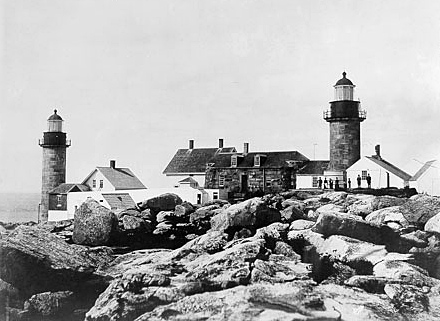
An 1856 winter storm off the coast of Maine isolated Matinicus Rock Light from contact with the mainland for twenty-one days. Its keeper, Samuel Burgess, went to the mainland for supplies the day before the storm arrived. While Burgess was stranded on the mainland for three weeks, his sixteen-year old daughter Abbie heroically tended the two lighthouses and cared for her sisters and ill mother. At least three nonfiction children's books have been written telling the now famous story of Abbie Burgess: 1) Keep the Lights Burning, Abbie (1985) by Peter and Connie Roop, 2) a graphic novel, The Stormy Adventure of Abbie Burgess, Lighthouse Keeper (2011), also by Peter and Connie Roop, 3) and Abbie Against the Storm (1999) by Marcia K. Vaughan. A fictional adaptation, The Lighthouse Keeper's Daughter by Arielle North Olson, also utilizes many details of the Burgess story.
| The Lighthouse Keeper's Daughter by Ariele North Olson; illustrated by Elaine Wentworth (From: Amazon) |
In The Lighthouse Keeper's Daughter, Miranda tends the lamps of an island lighthouse in Maine while her father is stranded on the mainland during a winter storm. Miranda and her mother are forced to ration their supplies over the few weeks it takes for her father to return. He eventually returns with a small boat of supplies, including flower seeds sent by Miranda's grandmother. Miranda noted and lamented the barrenness of the small island when she and her parents first arrived there. When spring arrives, seafarers demonstrate their gratitude for Miranda's light maintenance during the storm by delivering garden soil to the island. The story ends with the lovely scene of Miranda planting flowers on her rocky island.
| Minot's Ledge Light (From: Wikipedia) |
The story is generally supposed to occur on the coast of Maine. The news of Miranda's heroic effort to keep the lighthouse in operation "spread[s] all along the Maine coast." However, Olson specifies that Miranda's lighthouse is located on Minot's Ledge. Minot's Ledge is a barely submerged reef located one mile off the shore of Cohasset, Massachusetts--not Maine. There is a lighthouse on Minot's Ledge. However, Minot's Ledge Light is attached directly to the underwater ledge, with no island surrounding it. Furthermore, since its construction in the late 1840s, Minot's Ledge Light has always used an (at the time) cutting-edge Fresnel lens. In contrast, Olson has Miranda tending an older-style light with whale oil lamps and parabolic reflectors.
| Mount Desert Light (From: www.nelights.com) |
If we search for an actual lighthouse in Maine that is similar to Miranda's, there are at least two good candidates. One possibility is Mount Desert Light. Mount Desert Rock, as we have seen, is a barren island eighteen miles off the mainland with a long gardening history. Another possibility, Matinicus Rock Light, also eighteen miles off the mainland, was the historical scene of Abbie Burgess's heroism. But Matinicus Rock also has a fair amount of grassy vegetation and two lighthouse towers, unlike the single lighthouse in Olson's book.
There are several similarities between Abbie and Miranda. The lamp technology in both lighthouses was older than the Fresnel lens. They were oil lamps that needed more frequent tending. Abbie describes her practice with them:
| Matinicus Rock Light (From: www.lighthousefriends.com) |
Abbie and Miranda both come to the rescue of several hens endangered by the large storm waves washing over the island. Again, Abbie remembers:
"You know the hens were our only companions. Becoming convinced, as the gale increased, that unless they were brought into the house they would be lost, I said to mother: "I must try to save them." She advised me not to attempt it. The thought, however, of parting with them without an effort was not to be endured, so seizing a basket, I ran out a few yards after the rollers had passed and the sea fell off a little, with the water knee deep, to the coop, and rescued all but one. It was the work of a moment, and I was back in the house with the door fastened, but I was none too quick, for at that instant my little sister, standing at the window, exclaimed: "Oh, look! look there! the worst sea is coming.
That wave destroyed the old dwelling and swept the rock. I cannot think you would enjoy remaining here any great length of time for the sea is never still, and when agitated, its roar shuts out every other sound, even drowning our voices." (New England Historical Society)
But Olson distinguishes Miranda from Abbie in a number of ways. Sixteen years old at the time of her ordeal, Abbie was a few years older than Miranda appears to be in Wentworth's illustrations. While Miranda's mother keeps her company on the island while her father is away, Abbie was compelled to not only maintain the two lights, but also care for her ill mother and two younger sisters. Finally, there is nothing in the historical record (that I've encountered) to suggest that Abbie was particularly interested in flower gardening, as Miranda is.
The Lighthouse Keeper's Daughter, published in 1987, has not aged well. Elaine Wentworth's watercolor illustrations of the Maine coast are indistinct and dull. Even for a child who is interested in Maine, I think it would be difficult to get her to pick it up to read. I love the coastal scenery in which the story is set, but only mildly enjoyed the illustrations. Add to this the problem of the story's indistinct setting. I can understand why Olson did not locate the story on a particular island and lighthouse in Maine. She wanted to tell a story that combined Abbie Burgess's tale with Mount Desert Rock's history of gardening. But why mention Minot's Light in Massachusetts? This detail seems to serve no purpose in the plot. It only confuses the reader. For these reasons, I would not recommend this book to children, or even to any adults who are not, like me, so crazy for New England history and geography that they'll read everything ever published about it!
Sunday, March 6, 2016
The Day It Rained Forever
When you read historical fiction about a natural disaster, your reading mood takes on a dark and pessimistic cast. You already know basically what will happen in the end. And it will not be good. At the beginning of the story, the characters are not aware of the calamity awaiting them. And the reader’s thoughts are caught in a repeating loop of sad thoughts; “if only they knew, they could save themselves!”
These were my thoughts as I began to read Virginia T. Gross's The Day It Rained Forever. The book tells the story of the fictional Berwind family and their survival during the Johnstown Flood of 1889. The story goes nearly as expected, considering that the flood ranks among the worst natural disasters in U.S. history. Although 2,209 people died in the flood, most of the Berwind family survives, despite a near death experience for Mrs. Berwind. A Berwind uncle, Herbert, is not so fortunate as his house is located on a street bordering the Conemaugh River in Johnstown--directly in the path of the wave.
The book begins with a conversation between Mr. Berwind and his neighbor, Mr. Koehler, on May 30, 1889 as the rain begins. Koehler warns the Berwinds of the weakness of the dam on the Conemaugh River. He believes that due to the poor repairs and maintenance of the dam by the South Fork Fishing and Hunting Club, an eventual collapse of the dam is inevitable. Mr. Koehler leaves the older Berwind children, Christina and Frederick, with worries about the dam. Mr. Berwind dismisses Mr. Koehler's warnings as the stories of an overactive imagination.
Mr. Berwind's dismissal of Mr. Koehler's concerns is in fact representative of a common opinion among residents of the Conemaugh River valley at the time. As the water level in Conemaugh Lake continued to rise on May 31, 1889, John Parke, the South Fork Club's engineer rushed by horse to the town of South Fork. He telegraphed to the authorities in Johnstown his belief that a dam collapse was imminent. But Johnstown authorities did not respond. They believed that this storm was not unlike past storms, during which many doomsayers had warned of a dam collapse--but none had occurred. Mr. Koehler argues that the wealthy members of the South Fork Club had cut corners in maintaining the dam. His concerns are verified by the historical record. Originally built in the 1840s by the state of Pennsylvania, the dam's center collapsed during an 1862 storm. When the Club bought the dam in 1862, the damage was repaired not with the puddled clay, slate, and rocks that were originally used to the build it; they filled in the gap with simple soil. The dam was lowered in order to build a carriage road across it, providing access to the upscale Club buildings across the lake. In the original dam design, culverts or pipes had been built inside the dam connecting the lake to the river below the dam; these would allow the lake to be drained in case of an emergency such as happened in the storm of May 31. However, the Club attached screens to these pipes in order to keep the valuable fish in the lake--remember, its full name was South Fork Fishing and Hunting Club. Members of the Club were wealthy industrialists from Pittsburgh who treasured their fish! On May 31, so much debris had built up against the screens that no water could pass through. When tremendous water pressure built up against a weakened dam with none of the emergency features of the original design, the result was a dam collapse and immediate danger to everyone in who lived in the river valley below.
The storm that began late in the day on May 30 continued through the night and into the next day. By early afternoon, the waters of the Conemaugh River in Johnstown had already risen about 10 feet. In the story, the Berwind farm is located safely at a high elevation above the river valley. Most of the Berwind family is at home before the collapse, but Mrs. Berwind is in Johnstown helping to prepare for the wedding of her brother-in-law Herbert Berwind. Herbert's home is located adjacent to the river. Even before the collapse, Mrs. Berwind and Herbert's fiancé, Lenora, are forced by rising water to the top floor of the house.
Conemaugh Lake broke through the dam at about 3:10 PM on May 31. Twenty million tons of water formed a wave as high as 70 feet and began racing down the Conemaugh River valley at a rate of 40 miles per hour. It took almost an hour for the wave to reach Johnstown fourteen miles away. Along the way, it picked up and carried buildings, trees, people, and almost all objects in its path. At a stone railroad bridge in Johnstown, debris, including kerosene and oil, piled up there and caught fire. The fire killed many people trapped there. Frederick Berwind in the story helps in the rescue and clean up effort for two days after the storm. He returns home shocked and in grief.
Is The Day It Rained Forever a believable story? What was the likelihood of the chain of coincidental events involving Mrs. Berwind and the infant described above? 2,209 people died in the Johnstown flood. The population of Johnstown alone (not including the other small valley towns affected) was 30,000 in 1889. There must have been a number of people who were able to survive the flood as Mrs. Berwind does. 98 children were orphaned by the flood. Thus, it seems possible that the parents of the weeks-old infant rescued by Mrs. Berwind is an orphan. The story is entirely believable.
Much of The Day It Rained Forever takes place well away from the flood at the Berwind farm on a mountain high above the valley. In this way, the author is able to avoid extended, graphic descriptions of the flood, its aftermath, and its effect on Conemaugh valley residents. Mrs. Berwind was, of course, swept up in the flood. After the flood, Frederick Berwind briefly relates the tragic scenes he observed at the stone bridge in Johnstown. Gross includes enough detail of the flood for children to grasp the graveness of the tragedy, but mixes a happier subplot of hope that arises out of the disaster. In fact, that is just what the Berwinds name their new infant, Hope. I recommend this book as a way for children to explore the human impact of the Johnstown flood, yet in a way that is not devoid of hope. It turns out that my dark mood upon beginning the book was not entirely warranted. There is hope even in the midst of the worst tragedies.
Johnstown Flood. (2016, February 6). In Wikipedia, The Free Encyclopedia. Retrieved 19:16, March 6, 2016, from https://en.wikipedia.org/w/index.php?title=Johnstown_Flood&oldid=703582453
Kolb, Charles C. "Johnstown Flood." Dictionary of American History. Ed. Stanley I. Kutler. 3rd ed. Vol. 4. New York: Charles Scribner's Sons, 2003. 483-484. U.S. History in Context. Web. 6 Mar. 2016.
| The Day It Rained Forever, by Virginia Gross (From: Amazon) |
These were my thoughts as I began to read Virginia T. Gross's The Day It Rained Forever. The book tells the story of the fictional Berwind family and their survival during the Johnstown Flood of 1889. The story goes nearly as expected, considering that the flood ranks among the worst natural disasters in U.S. history. Although 2,209 people died in the flood, most of the Berwind family survives, despite a near death experience for Mrs. Berwind. A Berwind uncle, Herbert, is not so fortunate as his house is located on a street bordering the Conemaugh River in Johnstown--directly in the path of the wave.
Gross brightens the story through a subplot based on a series of coincidences. As the story begins, a Berwind infant has recently died from illness, leaving a despondent family behind. Mrs. Berwind is unfortunately in Johnstown when the South Fork dam breaks upstream and a massive wave subsequently dooms the small city. But instead of drowning, she rides the high water before catching hold of a tree. Coincidentally, an infant riding alone in a wooden bathtub floats close enough for her to grasp it. In another coincidence, the tree she is holding onto as the water rushes by is adjacent to a steep hillside. A cobbler named Ronaldo Amici happens to be standing on the hillside when he notices her. He rushes to save her and the baby using a rope and broom handle. The infant is taken to the Berwind home during the flood's aftermath. The parents of the baby are never identified and a lawyer advises the Berwinds that they are free to keep the baby, who they have now named Hope. Thus, the flood brings an unexpected blessing to the Berwind family, a new infant that eases the pain caused by the first infant's death.
| Houses in the Johnstown Flood. (From: Wikimedia) |
| South Fork Fishing & Hunting Club buildings. (From: Johnstown Area Heritage Association) |
The storm that began late in the day on May 30 continued through the night and into the next day. By early afternoon, the waters of the Conemaugh River in Johnstown had already risen about 10 feet. In the story, the Berwind farm is located safely at a high elevation above the river valley. Most of the Berwind family is at home before the collapse, but Mrs. Berwind is in Johnstown helping to prepare for the wedding of her brother-in-law Herbert Berwind. Herbert's home is located adjacent to the river. Even before the collapse, Mrs. Berwind and Herbert's fiancé, Lenora, are forced by rising water to the top floor of the house.
| Terrain Map of the Johnstown, PA Flood, May 31, 1889 (From: John MacKenzie, University of Delaware) Click on link for a larger version. |
| Debris at the stone bridge in Johnstown. (From: Wikimedia) |
Much of The Day It Rained Forever takes place well away from the flood at the Berwind farm on a mountain high above the valley. In this way, the author is able to avoid extended, graphic descriptions of the flood, its aftermath, and its effect on Conemaugh valley residents. Mrs. Berwind was, of course, swept up in the flood. After the flood, Frederick Berwind briefly relates the tragic scenes he observed at the stone bridge in Johnstown. Gross includes enough detail of the flood for children to grasp the graveness of the tragedy, but mixes a happier subplot of hope that arises out of the disaster. In fact, that is just what the Berwinds name their new infant, Hope. I recommend this book as a way for children to explore the human impact of the Johnstown flood, yet in a way that is not devoid of hope. It turns out that my dark mood upon beginning the book was not entirely warranted. There is hope even in the midst of the worst tragedies.
Resources on the Johnstown Flood
"Johnstown Dam Disaster." YouTube. YouTube. Web. 06 Mar. 2016.Johnstown Flood. (2016, February 6). In Wikipedia, The Free Encyclopedia. Retrieved 19:16, March 6, 2016, from https://en.wikipedia.org/w/index.php?title=Johnstown_Flood&oldid=703582453
Kolb, Charles C. "Johnstown Flood." Dictionary of American History. Ed. Stanley I. Kutler. 3rd ed. Vol. 4. New York: Charles Scribner's Sons, 2003. 483-484. U.S. History in Context. Web. 6 Mar. 2016.
Friday, March 20, 2015
The Ghost of Peg-Leg Peter and Other Folk Tales of Old New York
If you're ever standing on the shore of Long Island Sound during a storm, you may spot an old sailing ship riding the waves with a full crew and passengers on board. The ship is engulfed in flames and has a screaming white horse chained to the fiery mast. The sailors and passengers on board are not people at all, they're ghosts. You are seeing the legendary phantom fire ship that haunts the Long Island Sound.
"The Phantom Fire Ship" is told by the American folklorist M. A. Jagendorf in his The Ghost of Peg-Leg Peter and Other Folk Tales of Old New York. Jagendorf's stories capture the history, myths, and motifs with which New Yorkers identify themselves. The fourteen stories' settings range from New York's early Dutch colonial days to the twentieth century. Like other American tall tales, they explain the origins of geographic features and place names in the New York City landscape. They celebrate New York ideals such as the freedom of religion and conscience, capitalistic progress and wealth-building, egalitarianism and the self-made man, and the fast pace of life of New York. These are all big words and big ideas about a big city. But the stories, of course, are written for children. This book makes the reflective adult reader consider the ways in which children's literature can transmit the values and origin myths that adults attach to a place from one generation to the next.
"The Tale of the Three Footsteps" explains why there are more rocks in the Bronx than there are in Queens on Long Island. In a battle over ownership of Westchester County and Bronx, the Indians chase the Devil with tomahawks and arrows out to the end of Throg's Neck. In his escape, the Devil jumps across the water to Long Island. Upon landing there, the Devil picks up all the rocks lying around him and throws them back at his antagonists. That is why there are few rocks on Long Island.
| Peter Stuyvesant (From: Wikipedia) |
Passing from the supernatural to historical, Jagendorf next tells "The Courageous Quaker of Flushing," a biographical story of the Quaker John Bowne. The Quakers were a pacifist religious sect
| John Bowne answering to Peter Stuyvesant. (From: Scribner's Magazine, now on Wikipedia) |
![]() |
| Anthony is dragged to down into the creek. The best illustration in the book! The illustrator was Lino S. Lipinsky. |
Washington Irving's version of the story is so close to Jagendorf's that I have to question the decision to rewrite Irving's well-written tale. Why would you try to rewrite a classic storyteller's work? A correspondent of Westchester County historian Frederic Shonnard states that Irving was the earliest source of the story. Whatever the origin, one has to laugh at the wonderful absurdity of this story. Imagine, a devil fish in the Hudson River! The hilarity is only increased when one discovers that a moss bunker fish (or menhaden) is usually less than fifteen inches long.
![]() |
| From: Frederic Shonnard, A History of Westchester County, Westchester, N.Y.: New York History Company, 1900: 147. (accessed 14 March 2015 in Google Books) |
| Mrs. Robert Murray entertaining British officers while Putnam escapes. (From: NYPL Digital Library) |
Despite the historical basis of the story, Jagendorf reports a fantastic and absurdly comical dialogue between Mrs. Murray and George Washington--who dines with her earlier on the same day as Howe's visit. "'The British are on the march,' said Mistress Murray. [Washington replies] 'I know that well, madame. But we'll escape and we'll win. At the moment we need just a few more hours. Old Putnam and his men are hard on the march to join the army that's up on the shores of the Hudson River. When he joins them, all will be safe.' [Murray responds] 'True indeed, General. Thee knowest well, he who fights and retreats a way, lives to fight another day.' They all laughed.' [my italics]" They all laughed? They all laughed!?! First, I highly doubt that Washington took the time to visit with Murray that day as his army frantically retreated. Second, Washington was extremely angry about the poor discipline of his army during the battle and retreat. This was hardly a moment to relax for a spell of polite conversation and light jokes.
| Cornelius Vanderbilt (From: National Portrait Gallery) |
"Commodore Vanderbilt's First Boat" is a mostly true story that takes on mythical proportions because its themes of entrepreneurship and the self-made man form part of New Yorkers' self-identity. Jagendorf tells the story of how Cornelius Vanderbilt, the teenage son of a Dutch farmer, bought his first boat. He borrowed $100 from his mother on the condition that he plow and sow an eight-acre plot of land owned by his father within three weeks time. Vanderbilt convinced his friends to help him with the work by promising them rides in his boat. When he buys the boat, he begins a ferry service from Port Richmond on Staten Island. Through hard work in ferrying passengers to Manhattan, he earns enough money to pay his mother back with $1000 added on to the original sum. Vanderbilt eventually became a wealthy man by expanding his shipping business.
The major facts of Vanderbilt's story are accurately told by Jagendorf. However, there are a few points to clarify. Jagendorf's story is entirely set in Port Richmond. Actually, Vanderbilt's family moved away from Port Richmond to Stapleton (another village on Staten Island's north shore) when he was one year old. His first boat purchase probably occurred there, not in Port Richmond. Also, Jagendorf uses an unusual spelling for the type of ferry boat Vanderbilt bought: piragua. The more common spelling for this boat is "periauger." It is a flat-bottomed sailing boat with two masts.
| A periauger. (From: Wikipedia) |
Mose is not Jagendorf's creation alone--there are many, many other stories of him. Mose the folk hero is based on a real person: a red-headed Bowery firefighter of the early nineteenth century named Moses Humphrey. Mose the folk hero of tall tales has hands as big as Virginia hams and can lift streetcars out of his way when rushing to a fire. Mose made an appearance in the world of children's literature in the wake of the FDNY's heroism on September 11, 2001. In 2002, Mary Pope Osborne published New York's Bravest, in which Mose rescues a baby from a burning building.
Most of Manhattan is laid out with a perfect grid of streets. This is due to the foresightedness of city planners, who surveyed the whole island from 1807 to 1811 and charted a neat arrangement of numbered streets and avenues. The city at that time covered only the lower tip of the island. But it was expanding at such a rapid pace that city planners knew it would only be a matter of time before the entire island was occupied. This is why lower Manhattan today is a confusing tangle of mostly one-way streets, but the rest of the island is much easier to find one's way around on. The city planners could easily survey future streets through uninhabited fields and forests, but they needed to respect parts of the island that already had streets and people living there, such as Greenwich Village. The irregularities of the street grid are due to houses, streets, or farms that existed before the 1800s.
![]() |
| The intersection of Broadway and the Bowery (site of Union Square) in 1831. (From: ecotippingpoints.org) |
As for the historical record, there is little doubt that street planning in the area south of Union Square was affected by Brevoort's resistance. The question is: how was it affected? Jagendorf's story states that "no street went through his farm [presumably during Brevoort's lifetime?]." Although his story title refers to a special elm tree, it does not explain the tree's impact on street-planning. But Frank Bergen Kelley, in his 1913 edition of the Historical Guide to the City of New York (see p. 106), notes that it was only Brevoort's favorite elm tree that was preserved by planners, not the whole farm. According to this guide, the tree was located between the present-day Broadway and Fourth Avenue on what would be 11th Street--only 11th Street skips this block. Traveling west to east, it ends at Broadway and continues on the other side of Fourth Avenue. This skipped block, the guide explains, was the true impact of Brevoort's resistance: his elm tree was saved! The tree was probably somewhere in the vicinity of today's Grace Church. Kelley's is the more likely explanation of Brevoort's impact. Laid out by Native Americans long before the Dutch arrived in Manhattan, Broadway predates Brevoort's farm and was not among the streets being surveyed in 1807. One can easily see on a map Broadway's curving (and imperfect) course through the Manhattan street grid today.
![]() |
| This is a detail of a map created by the city planners in 1828. Interestingly, 11th Street is unbroken here. (From: "Plan of the city of New York and of the island: as laid out by the commissioners, altered and arranged to the present time," NYPL Digital Collections) |
In "The Greatest Hoax in New York City," Jagendorf describes a massive hoax played on New Yorkers by two jokers named Lozier and de Voe. One afternoon at the Centre Market (Grand & Centre Streets), they alarm a gathered crowd with the news that Manhattan Island is slowly sinking into the harbor. This is due to the weight of dense settlement of the southern tip compared to the sparse population density on the rest of the island. But, not to worry! Lozier and de Voe have a solution. Manhattan should be cut in half. The lower half should be towed out into New York Harbor, turned 180 degrees, and pushed back for reattachment to the upper half. In this way, the heaviest part of the island would be in the middle, imparting greater stability and buoyancy. But this solution requires great manpower--thousands of men. Men for sawing the island, rowers for the boats towing the island into the harbor, blacksmiths to build the heavy chain needed to keep the island from floating out into the ocean, carpenters to build houses for all the workers, farmers to provide food for the workers. Lozier and de Voe begin hiring workers for the project. But on the appointed day to begin work, neither Lozier nor de Voe can be found. Slowly it dawns on workers that they have been duped by the two jokesters.
Jagendorf was not the first to share this story. The hoax has become an urban myth, inspiring a book-length investigation by the New York historian Joel Rose. From the standpoint of historical accuracy, there are a number of problems. The earliest documentation of the hoax comes a full thirty years after the supposed event in 1823-1824. In a history of public markets in the eastern United States, The Market Book (see pp. 462-464), Thomas de Voe shares the first known account of the hoax. De Voe explains that it was told to him by his uncle. There have been no other witnesses to corroborate de Voe's story; moreover, no contemporary newspaper or media reports of the hoax exist. It is difficult to believe that the hoax actually happened, given that no other testimony of the trick ever surfaced.
| R.H. Macy (From: Wikipedia) |
The basic facts of Macy's biography are well-established. But there is one point of disagreement, depending on who is telling the story: the origin of the red star in the Macy's logo. You have seen Jagendorf's explanation. However, the Macy's website's history section tells another tale. When R.H. Macy was a teenager on Nantucket, he signed on as a whaling ship sailor for four years. As a sailor, he had a tattoo of a red star inked to his arm. He thought of the red star as a symbol of success. Thus, the Macy's logo might have been the result of a superstitious attachment from his youth.
![]() |
| Brian G. Hughes, New York jokester. (From: The Hatching Cat) |
"The Irish Luck of Brian Hughes" relates the true story of the wealthy jokester Brian G. Hughes. Playing small-scale jokes on family and friends was not good enough for Hughes. The whole city was subject to his hoaxes. For example, New Yorkers once woke up to find the steps to the Metropolitan Museum of Art strewn with empty picture frames and tools--placed there by Hughes overnight. An immediate panic arose about which paintings had been stolen. In another trick, Hughes bought an alley cat and had it expensively groomed. He called the cat Nicodemus, the "last of the Dublin Brindle breed," and entered it into the National Cat Show. The anecdotes shared by Jagendorf of Hughes's tricks are all true. Hughes was without doubt a one-of-a-kind New Yorker. In New York, everything is done on a big scale, so why not jokes too?
New Yorkers are all always in a rush--so the myth goes. "The Clock Must Not Stop" is, Jagendorf claims, a true story of how the New York Life Insurance Company built what was at the time the tallest building in Manhattan--nine stories--and put a gigantic clock on top. Although designed and manufactured by a master clockmaker, the clock breaks one day after installation. The chief concern of the New York Life Insurance Company's president is that his company will lose the respect of the public by keeping a broken clock on the new building. The clockmaker suggests that the building superintendent sit next to the clock and turns the clock hands manually each minute until the clock machinery was repaired. The clockmaker and superintendent are heroic for their deeds in maintaining public respect for the New York Life Insurance Company.
| The Former New York Life Insurance Building, completed in 1899. (From: Wikipedia) |
I could not verify many other details of Jagendorf's story. He names the master clockmaker in the story as Mr. Henry Abbot, "the most famous clock engineer of the city." I was unable to find any records of a clockmaker by that name. In the story, Jagendorf claims that the large clock was manufactured in Boston. The clock on the 1894-1899 building was indeed manufactured in Boston, but by E. Howard Company, not Abbot. Finally, I could not find any evidence that the 1894-1899 clock broke soon after installation. I am reluctant to attribute this story to Jagendorf's fanciful imagination. He claims to have verified the story in the archives of the New York Life Insurance Company. I could not find any contact information for the company's archivists. It is worth noting that not even a monograph history of the New York Life Insurance Company contains any record of a company building at Broadway and Liberty. Hmm... what were you thinking, Jagendorf?!
![]() |
| The original hope tree on Seventh Avenue. (From: ephemeralnewyork.wordpress.com) |
The point of this book is not to recount history. Even when Jagendorf accurately chronicles history, it is in the style of a folktale. Jagendorf's folktales attempt to capture the essence and identity of New York. Isn't a story all the more powerful if it contributes to the city's mythology and is true? But clearly, not all of it is true. I enjoy Jagendorf's free mixture of fact and fiction. What fun it is to sort out! But I suspect that Jagendorf missed out on a major component of New York's identity: its incredible cultural and racial diversity from the very beginning. Couldn't some great stories be told about how many languages you hear spoken on the streets of Queens? Still, this book is thoroughly enjoyable to read. I highly recommend it for all children and adults who are interested in New York City's history and culture.
Saturday, December 20, 2014
The Fiddler of the Northern Lights
| (From: Amazon.com) |
Grandpa Pepin tells eight year-old Henry many French-Canadian legends, about the "great white owl--l'hibou blanc--or the terrible loup-garou, who was part man and part wolf," and about rabbits who dance on moonlit nights. Henry's brother and mother both insist that his Grandpa is just telling stories again. One moonlit winter night, Henry and his grandfather, hoping to find the legendary fiddler, go ice skating down the St. Maurice River. They return home to the rebukes of Henry's mother for being gone so long. But then they all hear a knock on the door--quite an unusual event for a winter night at a backwoods cabin. The fiddler of the northern lights is on the doorstep looking for a fire to warm himself up. Taking his fiddle from a black case, the man begins to play. With the northern lights dancing overhead, neighbors make their way to the Pepin cabin to dance inside. The fiddler played "all through the night, until they could dance no more." Just before dawn, the fiddler packs up his instrument. Stepping out of the cabin, he turns to the north and disappears into the woods.
Some of us have deep affection for the mountains and wilderness of northern New England. It's in the North Woods that city-dwelling Bostonians like me satisfy a craving for uneven skylines of spruces and white pines, perhaps as a backdrop to a mountain lake. However, it is books like The Fiddler of the Northern Lights that remind me of the whole Canadian province to the north of New England, namely Quebec. For Quebecois, you have to travel south to get to northern New England!
| Saint-Maurice River Drainage Basin (From: Wikipedia) |
The Fiddler is set in the forests of Quebec near the St. Maurice River. Today, the original headwaters and upper stretches of this river have been altered by the Gouin Reservoir. The reservoir was built in 1918 in order to control the river's flow and generate hydroelectric power at several points downstream. It is hard to say whether the setting of the story predates the dam or not. The stream pictured in the book is so placid as to be completely frozen over during the winter. Could this be the result of controlled water flow from the dam or is it just naturally so? In any case, much of the river today from the reservoir to its junction with the St. Lawrence River at Trois-Rivieres appears to be only a couple of hundred feet wide on average. One picture in the book depicts the St. Maurice as a very narrow stream, perhaps 30 feet or so. This makes me think of the some narrow streams I've canoed in the Adirondacks--the Osgood and Oswegatchie Rivers, for example.
| Oswegatchie River in the Adirondack Mountains of New York State (From: New York State Department of Environmental Conservation) |
The neighbors' dancing to the fiddle deep into the night also bespeaks an earlier time. If there's anything that contemporary children do deep into the night, it's probably either video games or (I hope!) reading a good book. Occasionally, I see a picture of fiddle dancing like this in the newspaper. It usually has senior citizens smiling and enjoying the music as in ye olden times. Community fiddle dancing events were a wonderful way to spend time with neighbors during most of the eighteenth, nineteenth, and early twentieth centuries, particularly in rural areas like the one in the Fiddler. There are similar scenes depicting the joy of rural fiddle dancing in Kathryn Lasky's Marven of the Great North Woods and in Laura Ingalls Wilder's Little House in the Big Woods.
| If you see one of these, RUN! (From: Wikipedia) |
Grandpa Pepin tells Henry many old folktales of French-Canadian origin, the Fiddler being the foremost among them. Most folktales have a long and complex history as they are told with innumerable variations in different times and places. I was able to find at least one version of each story Grandpa Pepin tells. "Those Damned 'Marionettes'" has a fiddler named Fifi Labranche who becomes convinced by a protagonist, Lababiche, to take up the challenge of making the northern lights or "marionettes' dance to his music. His success in doing so casts a spell over him so that he cannot put the fiddle down or stop playing a tune called "Money Musk" (the above video) all night long. He collapses into unconsciousness by morning. He cannot lift an axe for three months afterwards because of his soreness.
![]() |
| Square dancing scene from Laura Ingalls Wilder's Little House in the Big Woods. |
The legend of the loup-garou is probably the most well-known of the stories that Grandpa Pepin tells Henry. This is a terrifying half-man, half wolf creature. French-Canadian storyteller Louis Frechette relates one of many stories about this creature in his story collection, Christmas in French Canada (page 241). Frechette also explains in a footnote the central idea of the legend: "the loup-garou here, is not a sorcerer, but a victim of irreligion. A man who has been seven years without partaking of the Easter Sacrament falls a prey to the infernal power, and may be condemned to roam about every night in the shape and skin of a wolf, or any other kind of animal, according to the nature of his sins. A bloody wound only can release him." (242) Hmm... I wonder if Grandpa Pepin used the words "infernal" and "bloody wound" with Henry.
Finally, Grandpa Pepin's story about rabbits dancing on moonlit nights is a worldwide legend. This tale of rabbits in the moonlight is similar to the story of Cinderella in that geographically disparate cultures around the world tell strangely similar versions of both stories. For as much as you'd probably ever like to know about rabbit folklore around the world, see blogger Terri Windling's post "The Folklore of Rabbits and Hares." Folklorists continue to puzzle over an explanation of this phenomenon of a folktale or legend that spans the globe. Of Cinderella, historian Robert Darnton writes, "Folkorists have recognized their tales in Herodotus and Homer, on ancient Egyptian papyruses and Chaldean stone tablets; and they have recorded them all over the world, in Scandinavia and Africa, among Indians on the banks of the Bengal and Indians along the Missouri. The dispersion is so striking that some have come to believe in Ur-stories and a basic Indo-European repertory of myths, legends, and tales." (The Great Cat Massacre and Other Episodes in French Cultural History, 21) Grandpa Pepin's dancing rabbits just might go back into Indo-European pre-history!
Now, shifting gears, how about those northern lights! The northern lights certainly do move as if they were dancing, though I don't think they move as fast as your average fiddle tune. Most videos of the northern lights available online are time-lapsed, so it's hard to get an idea of the original rapidity of their movement. Full confession: I have never seen the northern lights. My father says he used to see them sometimes while driving in northern New York. But he hasn't seen them there for a couple of decades. How I'd love to see this amazing display!
If you want to see the northern lights, you need to travel to either the North or South Poles. The magnetic field of the earth is weakest at these two points. The northern lights are caused by collisions between electrically charged particles emitted by the sun and gasses in the earth's atmosphere. Except at the poles, the earth's magnetic field does not allow the sun's particles to reach its atmosphere. The color produced by the collisions depends on the type of atmospheric gas involved. The most common color of the northern lights is green, which is caused by the combination of oxygen and the sun's particles. For more detailed explanation of the northern lights, see the Northern Lights Centre.
The Fiddler of the Northern Lights is a picture book that tells the story of a special relationship between a boy and his grandfather in the backwoods of early twentieth-century Quebec. As often happens with this blogger, a story--the legend of a fiddler who make the northern lights dance--sparks their imagination to ask the questions, "What if this story were true? Can I imagine a world where this story is true or actually happened? What would that world be like?" These are the kinds of questions that make a person (or pair) set out ice-skating on a cold winter night in the wilderness! Of course, Grandpa Pepin and Henry did not ask these questions in the story, but one can easily imagine such questions running in their minds. I recommend this book for its feel of winter in the North Woods as well the cultural experience of French Canada. It reminds us that the northern lights are (or would be if I can ever manage to see them!) a magnificent phenomenon that inspire viewers with a sense of wonder.
Subscribe to:
Posts (Atom)